
Believers Are One Body
Rumaysa learns that Muslims share one another’s pain and discovers how gratitude, du’ā and self-improvement can help her respond to the suffering of others.
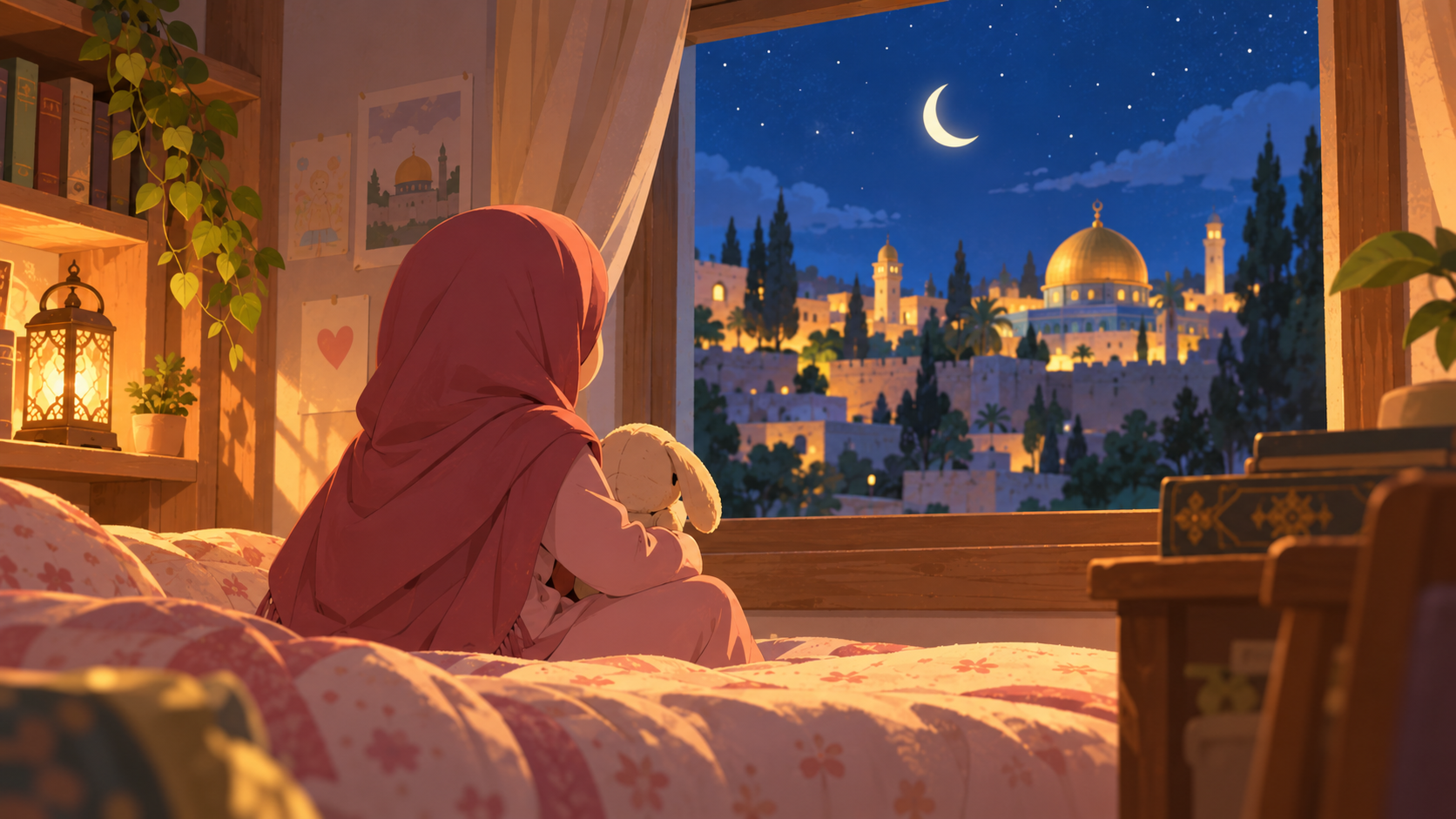
Rumaysa fell asleep once again, with her thoughts drifting to children just like her, but not like her at all. She had a full tummy that night, as she did every single night of her nine years. She had a home, whilst they had a tent with water leaking from a sagging roof. She had a family and someone to call “Māmā” and “Pāpā,” while they had no one to call upon but Allah. Silent tears rolled down her cheeks.
“Yā Allah! Please help them. Please let me help them.”
But how could she help them? And how could she be more grateful for all that she had? She had so much.
“Rumaysa, is everything okay?” Her mother’s gentle voice stirred her. Rumaysa looked at her through heavy, sleepy eyes. She hadn’t even noticed the door opening or her mother checking up on her.
“Māmā, I can’t sleep,” she admitted. “I can’t stop thinking about the children in Gaza.”
Her mother came and sat beside her on the bed. She ran her fingers through her daughter’s hair and prayed that she would find the right words to say.
“Rumaysa,” she said fondly, “it’s normal to think about them and others who are oppressed like them.”
Rumaysa sat up and leaned into the warmth of her mother, soaking in her familiar scent.
“Rumaysa,” she continued, “in one Hadīth, Nabi sallallāhu ‘alayhi wa sallam tells us that the believers are one body. If one part of the body hurts, all of the body hurts. So yes, we should feel the pain. And my dear child, we do feel the pain.”
The young girl felt relief and solace in her mother’s words.
“But Māmā, I wish we could help them,” she said softly.
Her mother smiled wistfully. “We might not be able to protect them, Rumaysa, or feed them or shelter them in our homes. However, we can make du’ā for them and all the oppressed every night, as that is their right over us. Dear child, what we need to do is be grateful to Allah Ta’ala and obey His commands, so that He accepts our du’ās,” Rumaysa’s mother advised her.
“Yes, Māmā,” Rumaysa said. She made a firm intention to make du’ā every chance she got.
“Māmā, In shā’ Allah, from now on I am going to wake up for Fajr with you,” she said eagerly.
Her mother nodded. “That’s a good idea, In shā’ Allah. Remember, my dear child, first, we must change ourselves and become better.”
Did You Know ..
– Palestine is home to the third most blessed Masjid – Masjid al-Aqsā.
– Masjid al-Aqsā was the first qiblah of the Muslims; it was one and a half years after the Hijrah that the qiblah changed to the holy Ka’bah.
– The reward of one Salāh in Masjid al-Aqsā is equal to the reward of 500 Salāh.
– Our beloved Prophet sallallāhu ‘alayhi wa sallam travelled to Masjid al-Aqsā during the Night Journey (al-Isrā’ wa al-Mi’rāj).
– Our beloved Prophet sallallāhu ‘alayhi wa sallam led all the prophets in prayer at Masjid al-Aqsā.